De Música
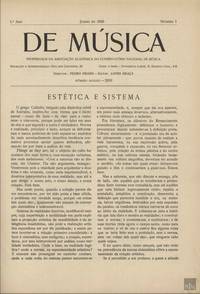
De Música magazine emerged at a time of prolific publications specializing in music. Throughout the 1920s and 1930s, several magazines with similar content and orientation were in circulation, such as Revista Musical (1924), A Clave de Sol e Música (1927), Lyra (1927-1928), Eco Musical (1911-1931), and Arte Musical (1930-1947). Most were very short-lived, with just a few issues or years, and De Música, published between June 1930 and May 1931 with four issues, is no exception. However, its structure and the featured essays and scores distinguish it from other contemporary music magazines. It lacks the usual news, upcoming, and reviews sections on concerts, as well as biographical profiles of composers or summaries of music history, typical of music periodicals from the late 19th century onward. Instead, De Música presented itself as an educational and reflective magazine, addressing aesthetics and musical theory and adopting a stance of defending erudite culture.
De Música faced a somewhat hostile environment to the type of periodical its editors envisioned. Fernando Lopes-Graça, editor of De Música, acknowledged that the magazine faced some unfavourable reactions from the outset. In an article he wrote on the sidelines of the 5th International Critics' Congress, held in Lisbon in September 1931, he produced a historical summary characterizing the periods and protagonists in the history of Portuguese music and assessing the country's cultural state, which was in crisis and considerably behind other European countries. The lack of specialized music periodicals contributed to the situation, and he cited the example of De Música, whose publication had ceased only a few months earlier, as the only one he considered capable of fostering a serious musical culture. However, as the author explained, De Música had been a victim of the narrowmindedness of the musical scene and the complaints to the Inspector of the National Conservatory raised by the critical commentary on the book by Alfredo Pinto (Sacavém), published in the first issue, were proof of this1.
Some of the issues addressed by Lopes-Graça in his critique of Pinto's book would be developed in the second issue of De Música. In it, Lopes-Graça assessed Portuguese music criticism and established steps for reforming habits and mindsets, arguing that public opinion should be left to experts. This perception that music critics and authors lacked the literary and scientific qualifications to guide the public resonated in the interview with Ilustração, also shared by his colleagues, and in several of the columns he wrote for the "Panorama Musical Português" series in Seara Nova. The publication of De Música is located, in the chronology of Lopes-Graça's essayistic and journalistic production, between his collaboration with two opposition publications: the newspaper A Acção (1928-1931), which he directed, and the magazine Seara Nova, for which he began writing in February 1931. These three publications provided, in the first years of Lopes-Graça's public life, dedicated spaces for the composer to express his thoughts on Portuguese musical culture, modernism, and nationalism in music, issues that he would continue to develop throughout his collaboration with Seara Nova and in other periodicals.
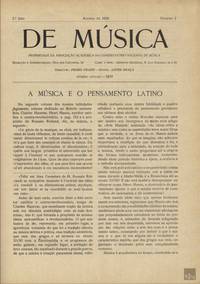
The articles published in De Música reveal some of the path its editors intended to follow, not only because of their content but also in the contributions they received. De Música was a space for the affirmation of a new generation of musicians who had benefited from the 1919 reform of the National Conservatory, carried out by José Viana da Mota and Luís de Freitas Branco. As Manuel Deniz Silva notes, although the magazine did not constitute an aesthetic manifesto of the so-called Group of Four, which included Lopes-Graça, Pedro do Prado, Armando José Fernandes, and Jorge Croner de Vasconcelos, it contributed to its definition as a movement and to giving it greater visibility among the Portuguese intellectual and artistic elite2. Edited by Prado and Lopes-Graça, who was one of its most regular contributors, De Música received contributions from Fernandes (the score of Scherzino, for piano) and Croner Vasconcelos (the score of Descalça vai para a fonte, for voice and piano, and the text of a lecture presented at a school audition). But it also benefited from the collaboration of other fellow musicians and/or students at the National Conservatory, including Francine Benoît (professor, music critic, and composer), Frederico de Freitas (composer), and Maria Helena Leal (pianist). The collaboration of the composers and professors at the National Conservatory, Tomás Borba and Luís de Freitas Branco, as well as the selection of two pieces by Francisco de Lacerda for publication and the article by philosopher Vieira de Almeida opening the magazine, can be understood as a search for validation of the periodical and its intentions among previous generations. As Deniz Silva points out, "les éditeurs de la revue fabriquaient ainsi, à travers le choix de leurs maîtres, une généalogie intellectuelle et esthétique pour la nouvelle génération musicale"3. Particularly relevant is the publication of "A música e o pensamento latino" by Luís de Freitas Branco, an article revealing Latinist ideals and a historical conception and defence of a new classicism that marked the composer and pedagogue's thinking. The article sparked an exchange of ideas between the author and Francisco Fernandes Lopes (a physician and music lover living in Olhão, with ties to Lisbon's musical scene), which highlights the space the journal intended to provide for the edifying debate of musical issues.
Mariana Calado
-
Fernando Lopes-Graça, “Panorama Musical Português”, Seara Nova, n.º 264, September 25 1931, p. 379.↩︎
-
Manuel Deniz Silva, “La Musique a besoin d’une dictature”: musique et politique dans les premières années de L’Etat noveau portugais (1926-1945), PhD dissertation, Université de Paris 8, p. 138.↩︎
-
Idem, ibidem, p. 139.↩︎