Pedro do Prado
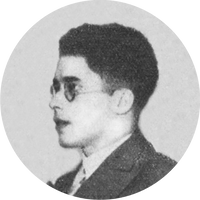 Fernando Lopes Graça
Editorial data
De Música was published between June 1930 and May 1931, over four issues. Although the publication frequency was never announced, it must have been more irregular than intended, as the time between issues was not identical.
Graphically, it presented a sober appearance: two columns per page and no illustrations, not even on the cover, which simply showed the magazine's title. It featured limited advertising for editions of literary and musical works by the magazine's contributors and the brands represented by Casa Olavo, a musical instrument and sheet music retailer.
De Música was founded by Pedro do Prado and Fernando Lopes-Graça, who held the positions of director and editor, respectively. Lopes-Graça was one of the magazine's main contributors, having written four articles, one for each issue, which would later be republished in the volumes of essays that Lopes-Graça published throughout his life (with the exception of the first one). Among the other contributors, the magazine featured mainly authors linked to the music world, notably Tomás Borba and Luís de Freitas Branco (composers and professors at the National Conservatory of Lisbon), Francine Benoît (professor, composer, and music critic), Francisco Fernandes Lopes (physician and amateur musician), and the contribution of philosopher Francisco Vieira de Almeida at the beginning of the first issue. Each issue included the publication of a score of piano or voice and piano pieces, the selection of which emphasized the identity of the magazine and its editorial team. It was also a way to showcase the work of some younger composers who would go on to shape the Portuguese musical landscape of the 20th century. Descalça vai para a fonte, from Redondilhas de Camões, by Jorge Croner de Vasconcelos (1910-1974), was published in No. 1, in June 1930, and, at the time of the composer's death, it was one of only two examples of works published during his lifetime1. The second issue featured Nocturno, for piano, by Frederico de Freitas (1902-1980); Scherzino, for piano, by Armando José Fernandes (1906-1983), dedicated to pianist Lourenço Varela Cid, was published in the third issue; Queixa…, for voice and piano, by Francine Benoît (1894-1990), based on a poem by António Sardinha, and two pieces by Francisco de Lacerda from Trente-six histoires pour amuser les enfants d’un artiste, for piano, in the fourth issue.
The editorial history of De Música can be linked to three entities: the Associação Académica do Conservatório Nacional, owner of the magazine; the Grupo dos Quatro, a term coined in the press to identify the young composers who were then emerging in the Portuguese musical scene, Pedro do Prado, Fernando Lopes-Graça, Armando José Fernandes, and Jorge Croner de Vasconcelos; and the Vergília do Canto Brandão (1900-1981) circle. A student at the National Conservatory, Canto Brandão organized an artistic and cultural salon at her residence on Rua Luís Bívar, in Lisbon, attended by young composers and other musicians and colleagues from the National Conservatory, such as Eduardo Libório, Ivo Cruz, Sarah Navarro Lopes, Antónia Colaço, and Florinda Santos, but also the painters José Tagarro, Tomás de Mello, Helena Vieira da Silva, and Arpad Szenes, the sculptors Ernesto Canto da Maia and Henrique Albuquerque, the actress and writer Manuela Porto and the philosopher Vieira de Almeida.
The Associação Académica do Conservatório Nacional was founded in 1919, according to Bertino Daciano2. This organization promoted concerts by music school students and works by Portuguese composers, but the specific extent of its activity is unknown. Pedro do Prado was director of the association when De Música was published, remaining in that position until 1939. Although the magazine was owned by the association and members were encouraged to subscribe, as Francine Benoît writes in an article about the magazine, it never mentioned the association or publicized its activities in any of the four issues.
The release of De Música coincided with the publication, in the magazine Ilustração, of an interview with the young composers Pedro do Prado, Fernando Lopes-Graça, Armando José Fernandes, and Jorge Croner de Vasconcelos (in which, however, the magazine was never mentioned) and with the holding of two concerts showcasing the works and musical program of the Grupo dos Quatro: in early May 1930, at the Academia de Amadores de Música, and about a month later, on June 5, 1930, at the 17th school audition of the National Conservatory. At this second concert, which featured works by composition students, Jorge Croner de Vasconcelos also gave a lecture, "O lugar da música na cultura geral", which would be published in the second issue of De Música.
The magazine’s abrupt end was neither anticipated nor justified. The last issue published featured a continuation of an article on musical vocabulary by Tomás Borba and a debate between Luís de Freitas Branco and Francisco Fernandes Lopes regarding Freitas Branco's article “A música e o pensamento latino", which had been published in the second issue. It also included essays on music theory by Fernandes Lopes, and on aesthetics and modern music, on Stravinsky, by Lopes-Graça; a review of a book by Irving Schwerké (American pianist and musicologist) by Henrique Costa; and, finally, a detailed presentation of the mission of the music school that Ivo Cruz and Eduardo Libório intended to found, the Cultural de Música. The publication's closure may have been due to a number of factors. The personal and financial effort involved in maintaining a specialized periodical was likely one of them. Lopes-Graça's arrest in October 1931 (first in Aljube prison, then exiled to Alpiarça) on charges of participating in the Organização Comunista de Tomar and publishing the newspaper A Acção also led to a prolonged absence that hampered the continuation of De Música. However, it is also possible that Lopes-Graça's commentary on the "Cultural de Música" project, published in Seara Nova, contributed to the situation. The school's ambitious project was presented by Ivo Cruz and Eduardo Libório in No. 4 of De Música and criticized by Lopes-Graça and the Seara Nova editorial team in this magazine3. The composer criticized, above all, the historical synthesis provided by the other two authors to support the relevance of creating the new music school. Could it be that, like the reactions to the critique of Pinto (Sacavém)’s book in the magazine's first issue, this commentary provoked further objections from the Inspector of the National Conservatory or a decline in support for the magazine's continuation by its authors? However, while the editorial project remained incomplete, its most participative contributors remained active in other press outlets, expressing their concerns and perspectives. Notably, Lopes-Graça began collaborating with Seara Nova in 1931 and, after settling in Coimbra, joined the Presença group; Francine Benoît continued writing music criticism and chronicles for various daily newspapers and magazines, most notably at that time, her position as music critic at Diário de Lisboa; Luís de Freitas Branco was then directing the magazine Arte Musical, for which he also wrote several articles, in addition to collaborating with other periodicals.
Mariana Calado
-
Gil Miranda, Jorge Croner de Vasconcellos 1910-1973: Catálogo razoado da obra musical, Lisboa, Biblioteca Nacional de Portugal, 2004, p. 17.↩︎
-
Bertino Daciano, “A música em Portugal (Subsídios para a sua história),” Arte Musical, March 30 1936, p. 6.↩︎
-
Fernando Lopes-Graça, “Panorama Musical Português XV”, Seara Nova, n.º 253, July 9 1931, pp. 203-207.↩︎